
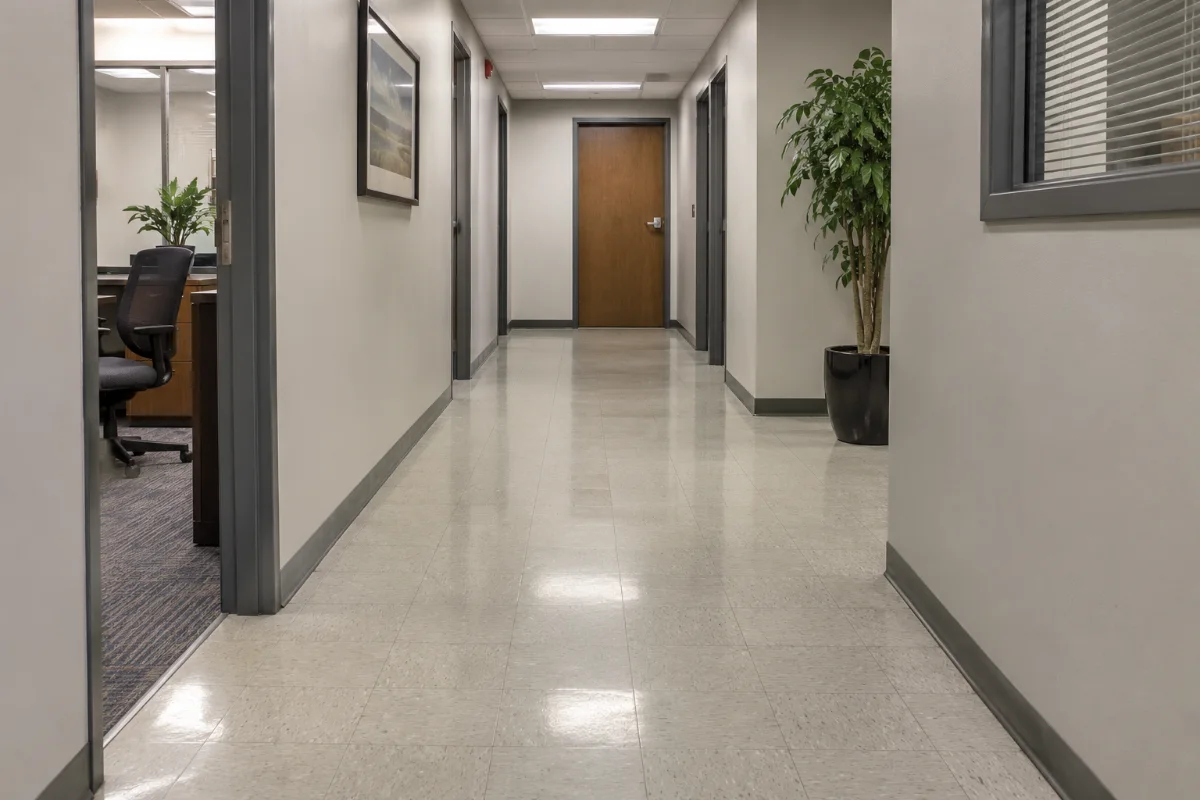
Most businesses need to strip and wax commercial floors every 6 to 21 months. Where your property falls in that range comes down to three things: how much foot traffic the floor takes, what kind of floor it is, and how well it's maintained between full strips. A busy store entrance might need it twice a year. A quiet back office can often go close to two years.
Here's how to figure out the right schedule for your building, and how to stretch it so you aren't paying for a full strip before you need one.
What stripping and waxing a commercial floor actually does
Floor finish (most people call it wax) is a sacrificial layer. It takes the scuffs, grit and abrasion so your tile doesn't. Over time that layer wears thin in traffic lanes, while dirt gets sealed into the coats along edges and corners. Mopping can't fix that, because the dirt sits inside the finish.
A full strip and wax:
- Strips every layer of old finish down to bare tile with a chemical stripper and a floor machine.
- Deep-cleans and neutralizes the bare floor.
- Applies two to three fresh coats of commercial floor finish, letting each one dry.
- Buffs or burnishes the new finish to a high shine.
It's the reset button for a resilient floor like VCT. It's also the most labor-intensive service in floor care, which is why getting the timing right matters.
How often to strip and wax floors, by traffic level
Use this as a starting point. Your walkthrough should confirm it, because the same building can have very different zones.
| Area | Typical traffic | Full strip and wax |
|---|---|---|
| Store entrances, checkout lanes, main corridors | Very heavy | About every 6 months |
| School hallways, cafeterias, medical waiting rooms | Heavy | Every 6–12 months |
| General office floors, break rooms | Moderate | Every 12–18 months |
| Private offices, storage, low-use rooms | Light | Every 18–21 months |
You don't have to strip the whole building on one schedule. Doing the high-traffic lanes more often and the quiet rooms less often is usually the cheapest way to keep everything looking consistent.
Signs it's time to strip and wax commercial floors
Calendars are a guide. The floor tells you when it's time. Plan a strip and wax when you see:
- A dull or cloudy finish that doesn't come back after burnishing.
- Yellowing or darkening, especially along walls, corners and under furniture where old coats build up.
- Traffic lanes worn down to bare or near-bare tile.
- Peeling, flaking or patchy finish.
- Black marks and scuffs that won't come out with normal cleaning.
- Mopping no longer makes a difference. The floor looks dirty right after it's cleaned.
If you're seeing one or two of these in a few spots, you may only need a scrub and recoat. If it's widespread, it's time for a full strip.
Scrub and recoat vs. strip and wax
This is where most businesses either save money or waste it.
A scrub and recoat cleans off only the top, dirtiest layer of finish and lays fresh coats on top of a base that's still sound. It's faster, costs less and causes less downtime than a full strip. Burnishing is high-speed buffing that brings the gloss back between those services.
A solid maintenance plan for a commercial floor usually looks like this:
- Daily or nightly: dust mop and damp mop.
- Weekly to monthly: burnish high-traffic areas to bring back the shine.
- Every few months: scrub and recoat the busiest zones.
- Every 6–21 months: full strip and wax.
Doing the in-between steps well is what pushes your full strip toward the long end of that range. Skip them, and you'll be stripping twice as often.
What affects the cost of commercial floor stripping and waxing
There's no honest flat rate for this work, because two floors with the same square footage can need very different amounts of labor. The main factors are:
- Square footage of the area being done.
- How much old finish has built up, and how many coats need to come off.
- The condition of the tile underneath.
- Access and scheduling: furniture to move, working around open hours, nights and weekends.
- Scope: full strip, scrub and recoat, or a mix by area.
That's why we walk every site before quoting. At Prime Floor Systems, owner Charles Penn looks at the floor, the finish and the traffic in person, then sends an exact written quote. You get a price for your floor, not a guess.
Keep commercial floors looking sharp between strips
A few habits go a long way:
- Use entrance mats inside and outside every door. Most grit that destroys finish walks in on shoes.
- Dust mop daily so sand and grit don't grind into the finish.
- Use a neutral floor cleaner. Harsh or high-pH cleaners eat floor finish and shorten its life.
- Put felt pads on chair and table legs.
- Stay on a burnishing schedule in high-traffic areas.
Need your floors stripped and waxed in Dallas–Fort Worth?
Prime Floor Systems provides commercial floor stripping and waxing, scrub and recoat and burnishing for offices, retail stores, schools, medical facilities and warehouses across Dallas, Fort Worth, Plano, Frisco and surrounding cities. We work nights and weekends so your floors are ready when you open, and we're fully insured.
Not sure whether you need a full strip or just a recoat? Request a free walkthrough and we'll tell you straight.
Frequently asked questions
Most commercial floors need a full strip and wax every 6 to 21 months. High-traffic entrances, hallways and store aisles sit near 6 months, while low-traffic offices can go up to 21 months if they get regular scrub and recoat or burnishing in between.
A strip and wax removes every layer of old finish down to bare tile and lays two to three fresh coats. A scrub and recoat only cleans off the top layer and adds new coats on top of a base that is still sound, so it costs less and takes less downtime.
Yes. Stripping is aggressive on the tile and costs more than maintenance. If the base coats are still intact, a scrub and recoat or burnishing will restore the shine for less and stretch the time between full strips.
It depends on the square footage and the amount of buildup. Prime Floor Systems schedules strip and wax jobs at night or on weekends and lets the floor cure overnight, so it is ready when your business opens.